Marching away from madness
Literary and mental spirals

Malavika and I live next to a school. For weeks, we were being awoken by the drone of music from sub-standard speakers. The school seemed to have correctly identified that to achieve maximum torture, a microphone could be placed in front of the speakers. Then the music through the sub-standard speakers could pass through a sub-standard microphone, and the resultant sub-standard sound could then play through the same sub-standard speakers from before. It was an ingenious method of torment. A glance out of the window was typically met with nervous toddlers shuffling on a raised platform. Facing them below the stage, where an imagined audience might otherwise be, were a gaggle of overzealous teachers. Though it would seem that they were not teachers as much as they were choreographers, barking instructions, dancing — themselves — with an enthusiasm that could only be conjured with the aid of some sort of amphetamine. It was all very positively insane.
Here is an inexhaustive list of songs they danced to:
Love you zindagi by Amit Trivedi
Titanium by David Guetta and Sia
Taki Taki by DJ Snake
Dil Chahta Hai by Shankar Mahadevan
In escalating states of rage every subsequent morning, we began to workshop sinister solutions. What if we called the police? What if we called the police to say that an animal of religious significance had been buried in the playground? What if we called the police to complain that we saw — emerging from the staff room — a man who was the spitting image of Jeffery Epstein? These jokes did not land well with my parents, who told me promptly that I should not be getting into any such trouble with the police. My father earnestly suggested that if I was so inclined to seek institutional recourse, I should speak to a lawyer. I could file a petition citing ‘noise pollution’, a curious cause that seems to seriously mobilise people of his generation. One day, in a moment of profound annoyance, Malavika did call the school to complain, only for her call to go unanswered. Presumably, they could not hear the phone ring over the music.
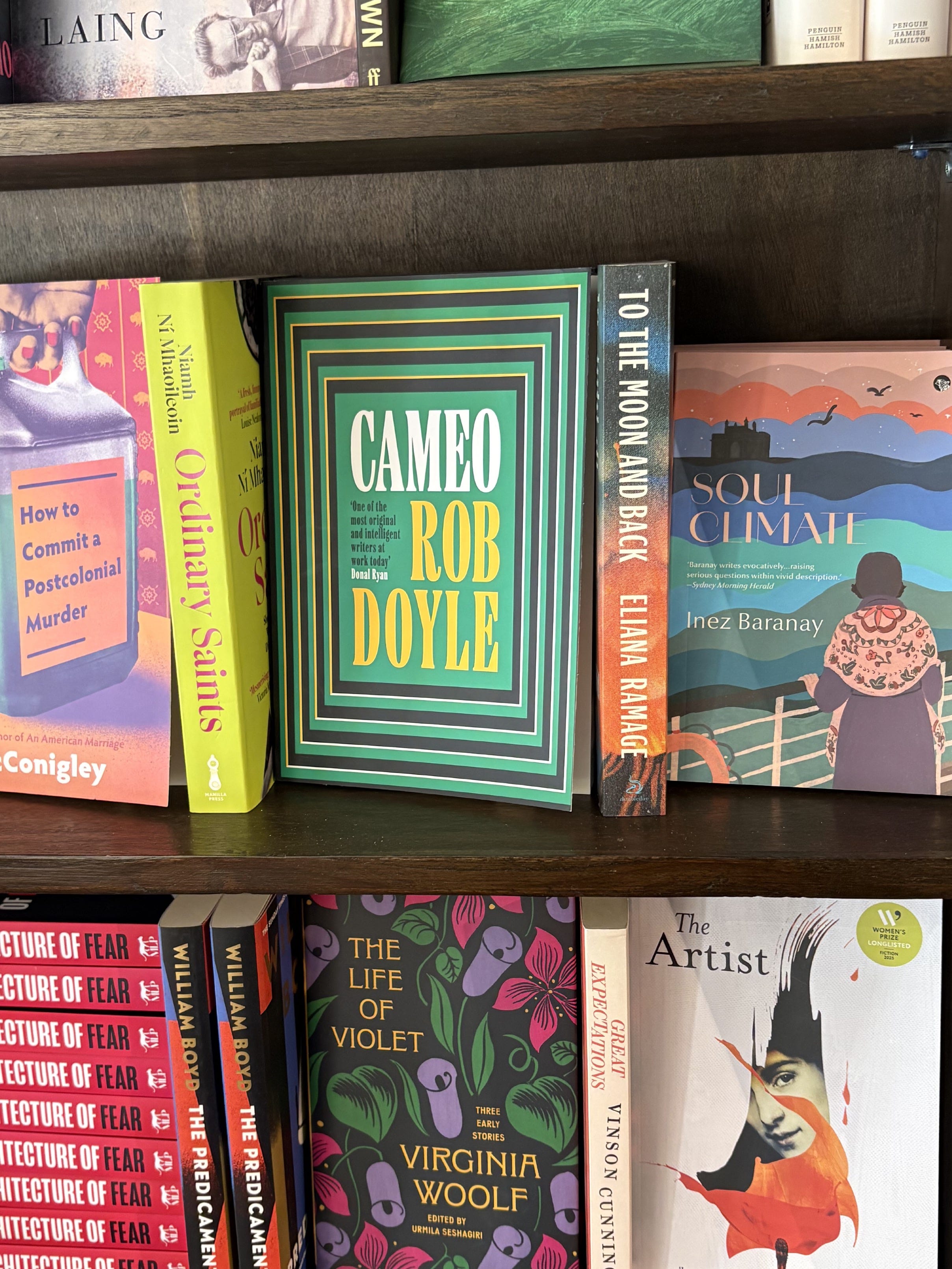
This has been a convenient rug to sweep my lack of writing under. But really, it is part of my descent into two spirals. The first spiral is of the good sort, a literary spiral. Rob Doyle’s latest, Cameo, has been a delightful encounter of stories nestled in stories nestled in stories. Cameo examines the life of Ren Duka — the autofictional persona of an unnamed author (who I assumed was Duka till eagle-eyed Malavika pointed out otherwise) — who finds sudden unprecedented worldwide fame. The book is structured in ten parts, each consisting of four sub-parts. We see the plot of several Ren Duka novels where Duka gets into increasingly high-stakes situations to manufacture dramatic autofiction. In some of the sub-parts, we glimpse into the lives of a magnetic string of characters: an American independent filmmaker-turned writer, a jaded actor who plays Duka in his hit-franchise biopic before being Me-Too’d, a manga artist in Japan, Rob Doyle himself. The novel therefore spirals from one plane of reality to another, a writer writing about a writer whose autofictional persona may or may not be the same as himself; more writers in the universe around them, and not to forget Rob himself. The cover, green with concentric black rectangles, is then a fitting reminder of the mirrors and spirals the reader contends with. I took much pleasure in reading Cameo: besides cementing Doyle as one of the best doing it out there, a personal favourite, I took it as a timely reminder that the great joy of writing fiction — and indeed the privilege of writing fiction — is getting to make things up.
The less fun spiral has been of my own creation. It has to do with a uroflowmetry test report from 2023. The uroflowmetry test in itself is a remarkable exercise: one is made to urinate into a funnel above a urinal; the funnel is fitted with sensors which produce a report with three different graphs mapping the pressure of one’s urine. This is the sort of document I imagine a footballer is shown at the end of a game by an analyst, telling him which areas of the pitch he ran around the most. Except it was for one’s urine. And in this case, my urine. This report that I remembered from 2023 showed a stuttering graph that the man conducting the test tutted at. The problem with my urination was the same complaint I had with my father’s driving: not fast enough. To top it off, I was retaining an unhealthy amount of urine, my bladder was simply not satisfactorily empty. I was due to travel so I called the doctor, who prescribed me benevolently with a prostate loosening pill. I promised to come see him when I returned to Delhi; a promise that I left cruelly unfulfilled.
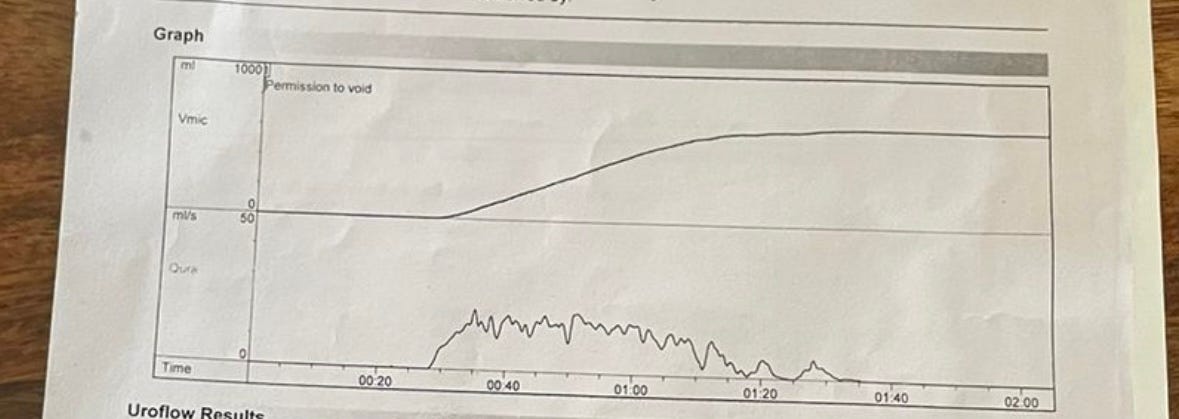
On my way to work, I recounted this saga from 2023. I found a picture of the report that I had taken on my phone. The diagnosis said ‘urethral stricture’. A quick glance on the internet informed me that this was an undesirable diagnosis. An exceptionally undesirable diagnosis, in fact, for the only cure was a urethroplasty — a complex surgery to reconstruct my urethra, after which I would have to spend four to six weeks urinating into a catheter. And after the pleasure of this surgical procedure, there was still a non-insignificant risk of recurrence.
In the quest for information I set aside my self-preservational instincts to punch the following words into my browser: “urethral stricture reddit”. The subreddit r/urethralstricture did not have a single story with a happy ending. I read accounts of young men who had multiple rounds of dilation, an attempt with Optilume, a drug-coated balloon inserted to fix one’s urethra, and then a reconstructive urethroplasty surgery; only for it to recur within weeks. I was fucked.
Every few hours I trawled through reddit. Then, as a man of the brain, I began looking through research papers. The National Institute of Health in the United States, one of the world’s foremost medical research centres, generously published work online for the benefit of medical professionals to refer to for complicated case studies and important scientific breakthroughs. Democratising access to this literature had not taken into account the possible audience of an anxious chump such as myself, sitting on the pot and furiously scrolling through pages and pages of work. There was a lot to take in. I began to study the shapes of uroflowmetry graphs and what diagnoses they signified — was the shape of my urine curve really a plateau, or was it a staccato curve? That would mean I had meatal stenosis, potentially less complicated to fix. Then I began looking up different types of urethroplasties. I found out that — supposedly — one of the best urethroplasty surgeons in the world was in Pune, where Malavika’s family was from. The doctor was so good that they named an entire surgical technique after him: the Kulkarni method. He ran an entire hospital dedicated solely to high volumes of urethroplasty surgeries everyday. Research suggested that the services of an experienced surgeon like Dr. Kulkarni could potentially increase the success of surgery exponentially. I read testimonials of patients who flew in from Kabul and Lagos and Tehran for Dr. Kulkarni’s expertise. Then I found one of Dr. Kulkarni’s junior doctors on YouTube. This man posted detailed demonstrations of the Kulkarni method, complete with squeamish videos of bloody urethrae being built with buccal mucosa removed from the patient’s cheek. Then I began to think through the logistics if I were to proceed: Malavika’s parents lived in Pune so they could perhaps verify if this doctor was indeed legitimate. I could stay at their house after the surgery.
I began to take action closer to home. I booked myself in to see a doctor in Delhi who came highly recommended, but was only available at the end of the week. In the quest for further knowledge, I began monitoring how long it took for me to urinate. My rigorous research informed me the optimal time to complete urination is in under thirty seconds. Like any rational actor, I opened the timer app on my phone, my thumb waiting to pounce on the START button the moment the first drop of piss left my body. It took me forty five seconds to empty my bladder. Over the next few days, results oscillated. Seventeen seconds, fifty four seconds, twenty eight seconds, thirty seven seconds. Sometimes my urinary stream appeared to split (a sign of strictures), sometimes it did not (strange, because a stricture was not reversible). Friday arrived with the promise of a qualified professional looking into my urine, as opposed to myself, a qualified unprofessional. Then the doctor cancelled the appointment.
Technically, the doctor rebooked my appointment for Monday. I decided that if he was to be unreliable with his schedule, it would be better to see him with my uroflowmetry results. With the knowledge of urology I had amassed over the past week, I knew that would be the immediate next step; or at least it should be, if this doctor was worth his (urinary) salt. I went to a different test centre than my first test in 2023. Malavika had been to the centre before, at the helm was a suave, handsome radiologist. A technologically progressive man, he informed me that while I urinated into the funnel-urinal contraption, he would stand outside with his iPad where my urine graph would draw itself in real time.
And here’s the thing: everything was normal. The doctor said that the moment I finished urinating. The curve was normal, the speed was exceptionally healthy, there was no urine being retained. I was completely fine. The report earlier was a false positive, a consequence of being plied with excessive water before my test and being made to wait longer than necessary. I was fine, really. I’d been fine all along. Nothing had ever been wrong. I could go home and write and read and do everything I’d not been doing for a week. (I must declare that I’ve still struggled to sit at my desk and write even since: it took me a couple of weeks to pick myself back up, and work has since piled up with a symposium our department is organising at the university.) I could chuck the report from 2023 in the bin, for all that mattered. Or to maintain fidelity to the form, I could delete the picture I still had of it from my phone. The past was over, the past was wrong, the past did not inform the present.
The real new lease of life, though, was given to both Malavika and myself the week after the test. On a Tuesday, I woke up to hear the birds chirping, the banterous cackles of young men cleaning cars, the gurgle of the moka pot. There was no music from the school. There were still children in the school which meant that they had not shut for spring, or worse, been shut down. No, Malavika told me, the rehearsals had reached a logical conclusion when I was at work the previous day, some sort of function where these hopeless children danced to their applauding parents. Time had helped us triumph. The worst was over. It was true, after all: all bad things did come to an end.
Then the next day Israel and the United States launched a ‘surprise’ military operation to bomb Iran.

good playlist by school
Cameo is very good.